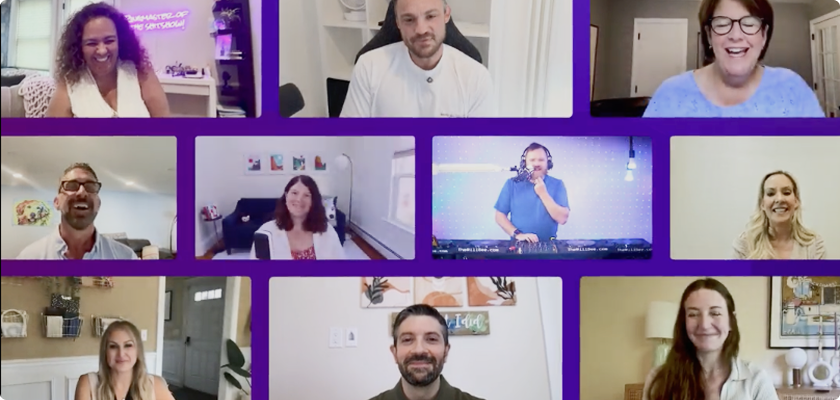
Rodney Hart: Hello and welcome into Event Perspectives. I’m Rodney Hart, VP of events at RainFocus, and another episode, another one I’m excited about. Joined by a former colleague, current friend, Kara Wooten, who is the director of global partner engagements at Dell Technologies. Kara, how are you doing?
Kara Wooten: Great. Good to see you, Rodney. Thanks for having me.
Rodney Hart: Thank you for joining. Thrilled about the conversation we’re going to get into. I think it’s a topic that those of us who run events and think about events always love: how do we continue to uplevel and make something resonate? But I don’t want to jump into the heart of the episode quite yet. I want to have a little bit of fun first. Kara, we’re going to do an icebreaker question. What is something that you’re obsessed with right now, and it doesn’t have to be work-related, but I do need to know why you’re obsessed with it?
Kara Wooten: Oh goodness. Um, this will be a little telling, so you wanted to get to know me: I really love binge watching. That’s my mind-numbing thing to take my mind off of work and all the stress. And recently I was recommended a series called “The Hunting Wives” on Netflix. It has a little bit of everything. It’s based in Texas. I’m in Texas, so I was intrigued. I’m a little obsessed with that right now.
Rodney Hart: I happen to like some of the actresses in it. I saw the trailer for “Hunting Wives” and I was definitely intrigued. And I’m curious: how accurate do you feel the portrayal of Texas is?
Kara Wooten: Well, there’s definitely some truth to it. I’m not in that part of Texas, so I can’t speak to all of it. I’m obviously in a much more metropolitan area, so I definitely think there’s some embellishment happening, but it’s fun nonetheless. Something great to escape to.
Rodney Hart: I’m a big binge watcher too. And I feel like in the event industry we hit it all the time: it’s not for the faint of heart. There are stressful moments, and binge watching, I’m going to say it’s a healthy coping mechanism. I’m curious though: what’s the latest you’ve stayed up binge watching a show when you have work in the morning?
Kara Wooten: So when I first started getting into Suits, there are like nine seasons. It took me a couple of tries to get through the first season, but after that I was hooked. I’m pretty sure I stayed up until 5:00 a.m. and I had a 6:00 a.m. wake-up call. So I’m not sure I ever went to sleep. There’s just something about the original Suits. I love to argue. I call it healthy challenges. I was just really intrigued. I love the intellectual side of that and I couldn’t stop.
Rodney Hart: 5:00 a.m. before a 6:00 a.m. wake-up. I don’t know. I mean, I’ve stayed up till 5 a.m. for sure, but not with a 6 a.m. wake-up. I’ll give you a nod there. All right, that was fun. We’re warmed up now. We know a little bit about you. Let’s go a little bit more into the corporate side and things that you’ve worked on. Tell us a little bit about the path that brought you maybe even before you were in events: kind of the path that brought you into the working world and then ultimately into events.
Kara Wooten: Oddly enough, I thought I was going to be a professional athlete when I was growing up. I played softball in college and very quickly realized that was not for me. I love the workout part of it, but I actually wanted to learn. So after my sophomore year I moved back home and finished college really quickly. I was very indecisive. I knew I had expensive taste, so I knew I needed a career that would pay well enough. I actually started out as a math major. I love math, I love problem solving. That’s definitely innate to my personality. But then after a couple of semesters, you go to your college counselor and talk about career choices, and they were sharing math professors or getting into statistics. None of that made my face light up. So I pivoted to psychology. Adolescent psychology was very interesting to me. I loved all the classes, very motivated in that, but I’ve always been the listener with my friends, the person they would come to talk to. I’ve got problem solving from the math side. But then I went back to my counselor and asked what I could do with psychology, and she shared the list of roles and I’m like, “That doesn’t pay well enough.”
So I said: I’ve gone three years in, I want to graduate, I’ve got all these credits, what degree can I get? She said, “Well, you need six more hours and you get a marketing degree.” So I was like, “Sign me up.” I went into marketing, which oddly enough has a lot of number crunching and needs data to support decisions. But marketing to me is the study of human behavior: we try to predict how we can motivate people to do X, Y, and Z. So I landed in a really great spot.
I’m in Houston, so I’m an oil and gas person. I worked in oil and gas for about 12 years before I came to Dell. Luckily I was in a software division, and yes, I spent time on rigs and all those things, but ultimately I was in software. That led me to Dell. I joined Dell in more of a business development role for the energy vertical for about the first four years. After that, Michael Dell made a big purchase called EMC, and we divested in verticals a bit. So I moved into our OEM organization and was running all types of marketing activities for North America: AR, PR, campaigns, messaging, communications, events. I got to really get a feel for what I liked and what I didn’t like. And I wouldn’t say that I love events, but for some reason events loved me. Every time something came up, I seemed to get my shoulder tapped: “Hey, can you help with this? Can you do this?” Eventually that led me to my current role, and I’ve been on this team for about six years at Dell Technologies. It’s our partner marketing organization, and for the first time in my career, about six years ago, I was solely focused on events.
Rodney Hart: I run to chaos. It’s that problem-solving nature. Tell me about that relationship with chaos in events.
Kara Wooten: I love it. And there’s something about events, although they’re supposed to be very well planned out: it’s that last little bit. I’m such a masochist. I secretly like it when something kind of goes wrong just so I can jump in and problem solve. And then there’s the adrenaline rush when everything goes like you hoped it would, even if there were snags along the way. I now lead the team I joined. We do far more than just events, including communications, OEM, and account-based marketing, but events are definitely near and dear to my heart.
Rodney Hart: So much I want to unpack. Running to chaos. I get it. And I think you either feel pulled to it or you’re just waiting for it. Like, great if everything goes smooth, but if an entire event goes smooth, everyone kind of looks around and thinks, “Something we missed, or we didn’t push the envelope enough.” I’m really excited about this conversation knowing how much time you’ve spent outside of a dedicated corporate events team, interfacing with events from different angles. I’m curious: what did you feel like your first real moment in events was? Did you feel drawn to it in those earlier roles?
Kara Wooten: Honestly, the very first international trip I ever took, I was working at Halliburton for their software division, called Landmark. My first international trip was for an event our team was executing in Venezuela, of all places. And I literally couldn’t have been on the job more than three weeks. I had a really great mentor who I am still friends with today. She is still a mentor, a lifelong friend. Watching her methodically go through everything, “the devil is in the details,” which is something I tell my team all the time, that was something I did by nature but I didn’t realize how important it was in events specifically. Watching how meticulous everything was, how everything was thought out: it really started to show me this is something I could probably be good at. I didn’t know if I wanted to do it yet, but from agendas to welcome packets to the experiences to the follow-up, that was my first foray into events.
Rodney Hart: And I know very well the organizational things, trying to be flexible, but there are things you get stuck with or can’t get yourself out of. And being in the details, being around people who were more detail oriented early in my career: I realized very quickly this is not just about being really detailed. It’s a survival tool. Unlike sometimes other roles where you might not fully flesh something out and it becomes somebody else’s problem, in events those details you didn’t iron out are your problem. They’re only going to be your problem later. If you’re not solving them today, it doesn’t go away tomorrow. If anything, someone’s going to be standing in your face saying, “Hey, I got a problem and you didn’t solve it for me yet.”
Kara Wooten: It’s actually predictive problem solving. I say this to my team: you don’t have to plan for good. When good happens to you, life is great. It’s a gift. You do have to plan for bad. I’m so big on contingency planning. I always talk about the first finger we should point being at ourselves: did we do everything within our control to prevent any of these possible outcomes we don’t want to see? Are we going to know everything that could possibly go wrong? No. But there’s something intriguing and fun about that. Call me a masochist. I just don’t want it to happen. That’s where the psychology, the study of human behavior, comes in. I get to do that. I want people to experience things they haven’t. I don’t want them to know how much hard work went in the back end. That’s one of the most underappreciated jobs you will probably have in your career. So I don’t really look for atta-boys and pats on the back. I actively seek out the criticism. How could we have done this differently? What did somebody not like and why? And I don’t take it personally. And that’s also what’s really fun about it. I don’t love monotony. I’ll get bored with something really really fast. So if we’re doing the same thing over and over again, that’s not a challenge. We can repeat things. You don’t need to fix things that aren’t broken. But I think there’s always a way, even if it’s a tiny little tweak, that you can change things up and make it feel a little different while still delivering on your objectives.
Rodney Hart: I’m going to get there in one second to ask about how you continue to make your events stand out. But I want to ask: what’s your current thinking about events as a marketing channel? You talked about how it’s not the only thing you’re overseeing right now. How do you think of events compared to those other channels?
Kara Wooten: Now more than ever, I think they’ve always been important but haven’t always gotten the right reputation because they’re really expensive to put on or to attend. And it’s not always in terms of money. Events usually pull on all resources: time, people, and money. So how do you redirect that? At the end of the day, to me, the core of events is around connection. In most businesses, not all, but a lot, you’re buying based on relationship. There are some commodity products where there may be four to six similar options in the market. So what makes this different? Usually it’s not the product itself. It’s the person you’re dealing with, the people at the company that you know are going to be there. And the only way to get to know somebody is not through the screen, which is predominantly how people communicate today. Very rarely do we pick up and call somebody on the phone, let alone go sit down and have lunch. We’re emailing, chatting, texting. You can’t really build relationships like that. Not deep ones.
An event could also be sending a salesperson to go deliver donuts in the morning at a shop just so their face is known. We forget that events don’t have to be these 5,000 to 10,000-person things. Anytime there is a connection, a purposeful point and meeting, that’s an event. It doesn’t have to be massively produced. It should be thoughtfully produced.
Rodney Hart: And in this world now where there are more events, more return-to-office movements, more distributed workforce, more events competing for budget: how much do you think about needing to make this compelling enough for an attendee to show up?
Kara Wooten: This is not a new thing. It’s actually harder. I’ve always thought about how to make sure we have butts in seats, and the right ones. You really want to make sure you’ve got the right audience at the right time delivering the right content to get to your outcome. I think the events industry is definitely back pre-pandemic, but with that comes the downside of making sure you stand out. And it’s less maybe about travel budget. I think it’s actually people’s time that is so much more critical because there’s so many more things happening and competing for our attention. How do I make sure the experiences we’re designing are worth someone’s time? I know that businesses always have an objective. But if you put your attendee and what they will get out of it first, I think you’ll deliver just that much better of an experience. It’s hard. There’s so much we don’t know about any individual attendee. Having some really robust and healthy information on your contacts and audiences is helpful because everything is built around hyperpersonalization: “Is this going to be worth my time? What am I going to get out of it? And how long is this going to take me away from my family? Am I going to have so much work when I get back?” I do think we trend toward doing smaller events. Thankfully for me, that’s my niche and my favorite. But regardless of the experience, you really have to be mindful of how you’re going to differentiate yourself from any of the 15 to 20 other experiences this particular audience member is choosing between.
Rodney Hart: And one of the partner engagements I assume is one of the bigger ones happens at Dell Technologies World, your user conference. How do you navigate balancing that agenda within a large event framework?
Kara Wooten: So in the context of Dell Technologies World, it’s a massive event for all of our customers, partners, and technology partners. We share what we’re doing, where we’re headed, where we’re going. There’s opportunity for training, a lot of thought leadership. The piece I cover is for our indirect routes to market: anybody not buying direct from Dell. It’s a different conversation and a different language. The number one thing that has proven to be successful is: don’t do something for something’s sake. Really understand what your goals and objectives are. This is a massive endeavor. The company spends a lot of money. A few years ago we used to host a whole separate event within an event, which was a huge waste of money and time. The pandemic happened and we just don’t have all the resources, time, and money. So now: how do we use that same space as an opportunity to deliver on some key messages that are better delivered in person, without asking too much of their time?
So I think really defining your objectives. We can’t do everything for everybody at one event. You’re going to have to say no to a few things: this isn’t the right space, this isn’t the right time, it’s not for this audience. Pick those one or two things with the best ROI opportunity. Really lean into that. Be highly curated and informative.
The one thing I really don’t like is unnecessary exclusivity. When you have thousands of people on site and you do something for a hundred of them without a good rhyme or reason, that doesn’t feel good. If you put yourself in an attendee’s experience, you’re like, “Well, why didn’t I? I’m at that title, I’m at that company.” I really would prefer not to do that. So instead: go for the bigger opportunities, not the smaller few. Mix the messages you want to deliver, have an opportunity for feedback, and then have a little fun. We should always be trying to have fun. Even at work events, maybe not too much fun, but some of the best relationships, since we’re talking about connections, happen when everybody can let their guard down a little bit. Sometimes what people share is that their problem is only a symptom. And especially for our sales team, curating opportunities that really let them have deeper, broader conversations is what we’ve evolved toward. This last year it felt really good. We got really great reviews. It’s about taking a flagship event, using the core of it, not competing with it, but curating a little lounge, having a special appreciation party that’s open to my entire audience, and allowing conversations that needed to be had to actually happen.
Rodney Hart: And at least I’m reading this and correct me if I’m wrong, but one of the questions I wanted to ask is: how do you know what to innovate or change versus what’s really working and attendees love and you should never touch?
Kara Wooten: You really can’t stay stagnant, especially where the world is right now. The world is innovating faster than folks can keep up with. I always think we should be innovating. If we don’t, we’re going to get left behind. I do appreciate that you don’t want to fix things that aren’t broken, and there are just some things that you get known for that people show up to because they love it. But it doesn’t mean there are no innovation opportunities. Whether it’s the design of the space, how you greet them, the swag you’re giving them, whether you add in some type of charitable opportunity, there’s always a little something. And it’s also a really great test bed. Where you have something attendees love is actually where you can change it up a bit and get really honest feedback. They’ll tell you: “I hate that, that didn’t work. Oh, I really liked that, I didn’t think I would. Or: I didn’t even notice.” And things they don’t notice might be things that saved you a lot of money.
Rodney Hart: And feedback: you’ve mentioned ROI, and the anecdotal feedback, I think that’s actually one of my favorite ways of using the new AI models out there. Taking what used to drive me insane as a data person, which was tons of written feedback with no way to get through it, and now you can make real cohesive trends out of that. I’m almost like: what does 4.72 versus 4.61 mean? Just tell me. Give me a few questions, give me the written feedback. But I’m curious, from your perspective when you’re executing events, are there key data points you’re looking for beyond butts and seats?
Kara Wooten: How long did they stay in their seats? Were they on their phones the whole time or actually paying attention? Were they taking notes? Did they ask questions after? A lot of what makes a difference on how we make decisions today are not things you can just sit there and calculate. You’ve got to have the right people in the room assigned to looking at those things. Use AI to monitor them, but also really pay attention and get anecdotal feedback. And don’t ask them two days after they’ve gotten home and had really crappy flight delays. I want to get you as you’re walking out of the room. Let me walk you to your next session. “Where are you going? Great. So, what do you think about the last one?” Really be purposeful in the moment and get that gut-shot reaction. Then marry that up with whatever your raw data tells you: how many people showed up? How many people were there at the end? And we calculate that.
For me, the activities and experiences we lead are the ones we’re going to do every year regardless of the outcome. We just want them to be the best they’ve ever been. It’s far more about relationship building than driving revenue and pipeline in that moment. Obviously we always want to do that, but this is one step on that journey. If the result is a shorter sales cycle, you can get that feedback from your sales representatives.
Rodney Hart: And did you find, because I feel like this is something we’ve seen at RainFocus and in conversations we’re having, that in-person is just more impactful for driving that business forward? Like the relationship versus the virtual alternative?
Kara Wooten: I think it’s taken on a whole new dimension for me. There are definitely certain regions globally, because I manage a global team and do global things, where virtual or hybrid is a huge opportunity. It’s just harder to get to some places, traveling internationally takes more time and effort. So what you’re delivering on site has to be so compelling. When it’s not, some people may choose virtual. But what we’ve seen is that for live events, you’re not going to have large virtual audiences, because at the end of the day it’s still about connection. They want to be able to ask a question, interact. Otherwise it’s on demand, and that makes great sense for things like training. But when you’re trying to really drive thought leadership, when you’re trying to further relationships, especially here in the United States, virtual is definitely not as effective. People really missed it. And there’s something, as much as we’re sitting here as buds and friends, there are some things I might tell you if I’m sitting right next to you at an event right after we just heard a speaker that we wouldn’t share here. So I think being really prescriptive on your objectives, going back to that: what do you want to get out of this?
And I’m always pressure testing this with myself too. The number of times I see a compelling email for a webinar with people I want to see, but I’m just like, “Maybe.” And I don’t know if it’s overwhelm, or because there’s so much time required when you’re on site in person, you have to really commit. Sitting at your desk, the commitment is low. And what most happens is something else comes up. You’re like, “Oh, they’re probably going to record it. I’ll go back and watch it later.” And you don’t. Best subject line ever, and you’re still not tuning in live. The opportunity cost for you is low when it’s virtual. It’s high when it’s in person. You know it’s 1:00 p.m. Eastern, you’re about to join, then you get a Slack message, and you’re like, “I really have to finish this. I’ll come back to it.” And you don’t. And then it’s the end of the day, and hey, let’s put on “Hunting Wives.”
Rodney Hart: And before I get to the closing question, I did want to ask: we’ve talked a lot about innovation and inspiration. Where does it come from for you? Is it educational opportunities, networking, peers?
Kara Wooten: It could be all of the above. Most often it comes when I’m not looking for it. I’ll use an example because I think this happens more than people realize: I use a lot of real-life experiences wherever they may be. I was visiting a friend in Jacksonville, Florida. We went and got our nails done, and the aesthetic of this nail place was beautiful. I took pictures of it. I thought, “Man, we have a global partner lounge at Dell Technologies World. I wonder if this will fit in.” Then we went to a little beach bar. I said, “There’s something about this aesthetic I love. We need to pull that in.” You start with the aesthetic and then build out into what you want people to feel, what’s the objective, how you want them walking in. I put together a mood board and then go talk with the team.
Yes, I love the industry piece and hearing from peers: what worked and what didn’t. Other people’s failures: “That was a really good idea, how could I go do that?” But I find the things that we actually end up bringing to life are not related to the job or the industry. It’s just the real-life things. Places I’m going with the kids, places I went with my friends, something you see on a show. And then it just gets my brain going.
Rodney Hart: Amazing. So many good things. I could keep going but I try to keep these things from going on for hours. Let’s get into the last question, which is around the event industry. It’s a stressful place to be. What is one piece of advice, something you’ve heard and live by, or something you’ve just learned over time, that you’d share with someone young and coming into the industry?
Kara Wooten: This is not for the faint of heart, and you need to be a self-starter. I coach my team all the time: the only dumb question is the one that you don’t ask. The more you understand, the better you’re going to be able to deliver. And if you don’t understand, I know there’s this whole “fake it till you make it.” Sure, you want to do that, right? But also show up and have a point of view. Ask a lot of questions and then have a point of view. I think a lot of younger-in-career people think, “Oh my goodness, I don’t have any experience. I’ve got to keep my mouth shut.” Actually, today our audiences are starting to look a lot more like them than they are like me. So having robust input from different generational perspectives and how people work is incredibly valuable. I don’t want them to stay quiet. If they do, I don’t want to call them out on a team call. Some people are just uncomfortable when they’re new. But I’ll say, “Hey, it looks like your brain’s working. Can we touch base after this? I feel like you have some thoughts, let’s do it.” They need to feel optimistic. There’s a level of confidence they should have because they do have life experiences that will help them in their role. They just have to be able to articulate that. So ask a lot of questions and have a point of view.
Rodney Hart: And it’s so important for those of us working with people younger in career to make it a safe place to ask questions. There is something to “fake it till you make it” but not to the degree that you’re not learning. And the ability to ask questions in an environment that encouraged me asking questions also really inspired me. And being on the flip side of those questions, realizing: “Whoa, what a great question. You not knowing that tells me something I haven’t said or explained, that I took for granted. And that also means our attendees probably have no idea.” You get something out of it too. It’s actually super beneficial. Love that. Kara, so much fun. I’ve got one more section.
Kara Wooten: One more. Literally one more.
Rodney Hart: This is purely for fun. There are no wrong answers. Unless I chime in, then I’m the one breaking the rules. It’s called the lightning round. I’m going to fire away some questions and you answer with what comes top of mind. Are you ready?
Kara Wooten: Let’s do this.
Rodney Hart: Who is your dream guest keynote speaker?
Kara Wooten: Well, two. One would be Mel Robbins because I freaking love her. I would just love to hear her on a stage. But there’s a newer one: his name is Jefferson Fischer and he is all about how to have difficult conversations in all facets of your life. He is so good about keeping your space but having those difficult conversations and not leaving people upset after you have them. So those are my top two right now.
Rodney Hart: That second one is new. I’m going to look that up. True or false: you prefer smaller intimate events over large-scale ones.
Kara Wooten: Completely true. A thousand percent.
Rodney Hart: The best airline is United.
Kara Wooten: Window seat or aisle seat?
Rodney Hart: Window seat.
Kara Wooten: Window all the time.
Rodney Hart: True or false: networking is your favorite part of attending events.
Kara Wooten: Way false. I wish it were, but for me I’m an introvert. I just sit up against the wall.
Rodney Hart: What is your favorite part?
Kara Wooten: After it’s over. The flight home.
Rodney Hart: Yeah. If you could host an event anywhere in the world, where would it be?
Kara Wooten: I’ve done a lot of really great places, but the one I haven’t and I want to go to is Australia. The Australia, New Zealand area. I need to get to the southern hemisphere.
Rodney Hart: What’s your go-to comfort food during event planning stress?
Kara Wooten: Starbucks.
Rodney Hart: Okay. What’s your current favorite mobile app?
Kara Wooten: My Oura Ring app. I’m a big Oura person. Talk about stress: I actually seem to manage it really well, but I like monitoring my sleep and seeing how I do.
Rodney Hart: True or false: you pack gym clothes when attending an event you’re planning.
Kara Wooten: Sometimes yes, sometimes no. Can it be both?
Rodney Hart: It can be both. It’s true that you often pack it. It’s false that you often use it.
Kara Wooten: Yes, I like that answer. Perfect.
Rodney Hart: Kara, thank you so much for your time. I very much appreciate it. I think there’s so much wisdom in this conversation and everything you shared. Thank you for joining.
Kara Wooten: Such a treat. Thank you, Rodney. Appreciate you.